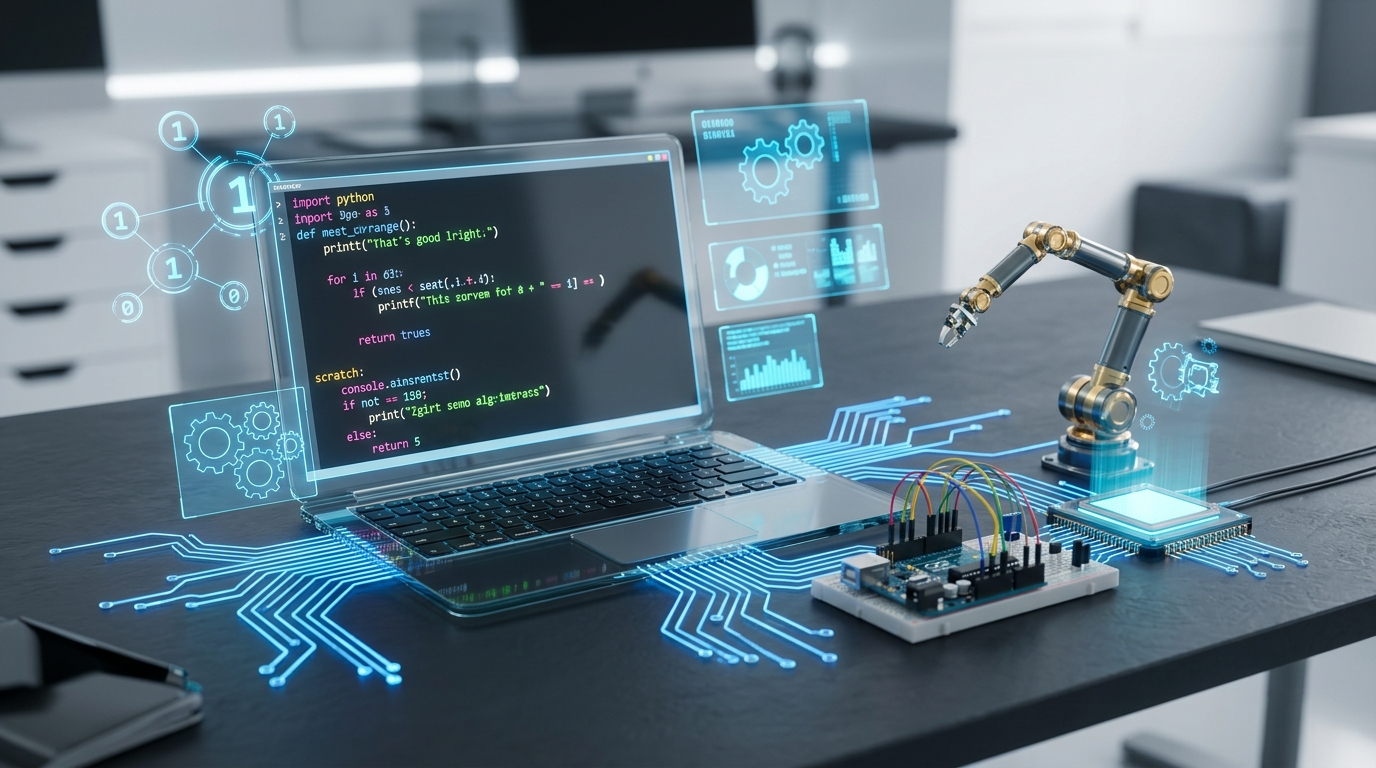
The IT & Robotics Revolution: Why Coding and Practical Computing Must Start in School
The rapid global emergence of artificial intelligence, automated robotics, and cloud-native software architectures is profoundly reshaping the 21st-century workforce. In Pakistan, preparing young learners for high-value economic opportunities requires moving decisively past basic computer typing drills into authentic computational thinking, algorithmic logic, and hands-on robotics engineering.
At Al-Faisal School System in Sheikhupura, we recognize that learning to code is not merely about writing lines of software syntax—it is a fundamental cognitive discipline that teaches children how to decompose complex challenges, identify structural patterns, design logical algorithms, and debug errors with resilience.
K–10 Computing & Robotics Curriculum Continuum
Our structured technology roadmap introduces concepts progressively according to each age group’s cognitive development:
1. From Passive Screen Consumers to Creative Innovators
Most children today interact with technology as passive consumers—scrolling short-form videos and playing pre-packaged mobile games. Early programming education radically flips this dynamic. When an eight-year-old student programs their own animated story in Scratch, they realize that digital games and applications are systems constructed by human thought and intentional logic.
2. Real-World IoT & Microcontroller Projects in Our Lab
In Al-Faisal’s dedicated Robotics and IT Lab, theoretical physics and coding meet. Students don lab coats and safety goggles to wire microcontrollers, program analog sensors, and build functional prototypes that solve real-world problems in Sheikhupura’s agricultural and urban landscape:
- Automated Soil Moisture Sensing: Programming an Arduino to measure soil resistance and trigger irrigation relays for water conservation.
- Autonomous Obstacle-Avoiding Rovers: Utilizing ultrasonic sonar sensors to calculate obstacle distance and steer servo motors.
- Digital Weather Stations: Reading ambient temperature and humidity sensors and displaying real-time data on LCD screens.
3. Digital Citizenship & Cyber Safety Ethics
Technological mastery without ethical responsibility is dangerous. Our computing curriculum incorporates comprehensive digital citizenship training: teaching students how to safeguard personal data, verify online sources against disinformation, prevent cyber-bullying, and uphold Islamic manners in online communication.