Beyond ‘Ratta’ (Rote Learning): The Power of Hands-On Science Laboratories
For decades, the single greatest impediment to authentic scientific progress in Pakistani secondary education has been the prevalence of ‘ratta’—the mechanical memorization of textbook definitions, reaction equations, and mathematical derivations without empirical comprehension. When a student memorizes a scientific law merely to pass a test, the knowledge evaporates the moment the exam paper is handed in.
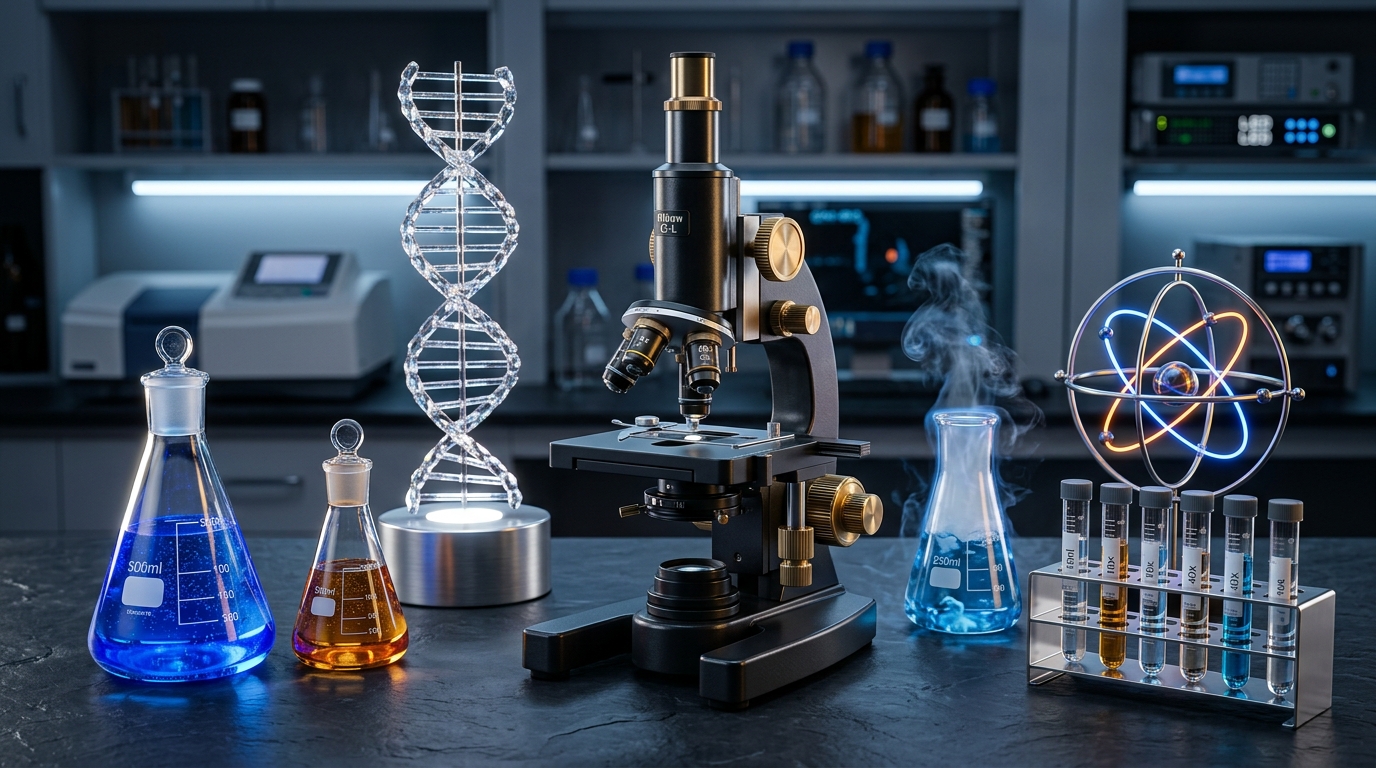
At Al-Faisal School System, science is not taught as a dead collection of historical facts; it is experienced as an active, investigative journey. Our purpose-built laboratories in Physics, Chemistry, and Biology serve as discovery studios where every student manipulates apparatus, records real-world data, and tests hypotheses firsthand.
Cognitive Comparison: Rote Learning vs. Empirical Inquiry
Educational psychology categorizes learning into cognitive depth levels according to Bloom’s Taxonomy:
1. Small Lab Batches & Individual Apparatus Handling
In many traditional institutions, a science teacher performs a single demonstration at the front of a crowded classroom of sixty students, while the majority observe passively. At Al-Faisal, practical science classes are partitioned into small laboratory batches of no more than twenty students. Each workstation is equipped with dedicated apparatus, allowing every learner to adjust Vernier calipers, calibrate resistance boxes, and focus microscopes independently.
2. Empirical Data Logging & Scientific Error Analysis
Real science involves managing experimental uncertainty. Students are taught to record raw observational tables, plot accurate graphical curves, calculate slopes, and identify experimental errors (such as zero error in micrometer screw gauges or parallax error in liquid meniscus readings).
3. Flawless 30/30 Preparation for BISE Practical Exams
Practical board examinations contribute substantially to the total matriculation science score. Our students maintain neat, faculty-verified practical logbooks, practice standardized viva voce oral questioning, and execute timed laboratory procedures with absolute precision, routinely securing perfect 30/30 scores in board evaluations.